

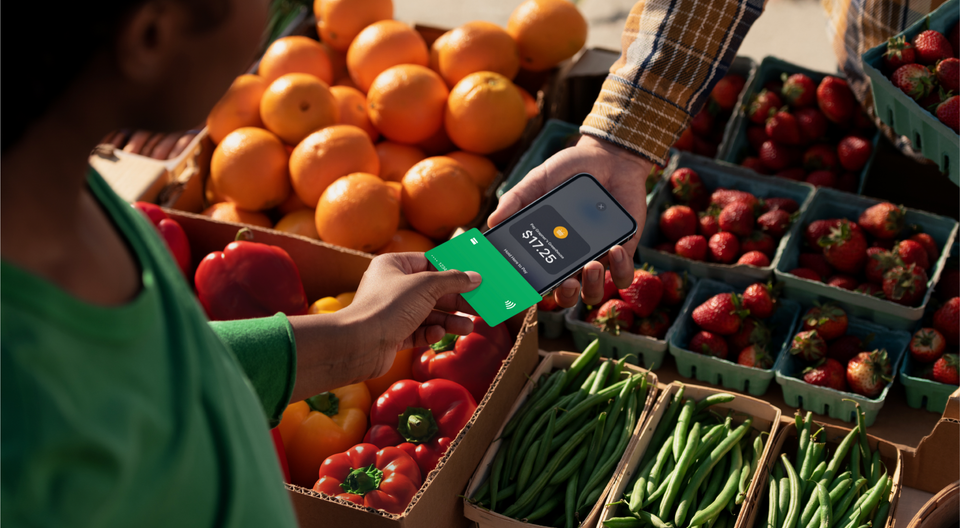
Your iPhone already has the hardware to read a contactless card. If you have been shopping for a card reader to plug into it, you can probably stop. Tap to Pay on iPhone turns the phone in your pocket into a payment terminal, and with the Payment app it connects straight to the Stripe account you already have.
Do you need a card reader for your iPhone?
In most cases, no. A customer paying with a contactless card, Apple Pay, Google Pay, or Samsung Pay just holds it near the top of your iPhone. There is no dongle to pair, no Bluetooth to fight with, and nothing extra to charge overnight. We have found this is the part merchants are most surprised by, because for years the answer was a small plastic reader and a tangle of accessories.
There are still a few situations where a physical reader earns its place, and we cover those below.
Which iPhones work as a card reader?
To use your iPhone as a card reader with the Payment app, you will need:
- An iPhone XS or later
- iOS 18 or later
- A Stripe account, in one of the 20+ countries where Tap to Pay on iPhone is live
- The Payment for Stripe app, which is free to download
Unfortunately, iPad will not work. It does not have the NFC hardware required to accept payments, so an iPhone is the only option here.
How do you turn it on?
Download the Payment app and sign in with your existing Stripe account through Stripe's standard OAuth flow. That part generally takes under thirty seconds. Then open Settings, tap Card Reader, and turn on Built-in Contactless Reader. Create a charge, hold the customer's card near the top of your phone, and the payment flows into your Stripe account in the exact same way it would from any Stripe Terminal card reader.
What does it cost?
Stripe charges 2.7% + 5c for in-person transactions, plus an additional 10c for each Tap to Pay authorization. The Payment app adds 1.2% per sale. There is no monthly fee, no contract, and no minimum, which matters quite a bit if your in-person volume is seasonal or only occasional.
When you still need a card reader
Tap to Pay reads contactless cards and wallets. It does not read a chip pushed into a slot, and it does not read a magnetic stripe. In addition, it needs an internet connection to authorize a payment, so it cannot store transactions offline the way a Bluetooth reader can.
There are also a couple of regional cases worth knowing about. In Canada and Finland, many issued cards are offline-PIN only, which means the card has to be physically inserted for the customer to enter a PIN. In the UK, depending on the issuer, Strong Customer Authentication can require certain cards to be inserted as well. In those situations the payment declines before the PIN screen ever appears, and the practical fix is a Stripe Reader M2 or a WisePad 3 kept nearby.
Imagine the following scenario: You run a booth at a weekend market. Nearly everyone taps a card or a phone, and your iPhone handles all of it without a second device. Then someone hands you an older chip-and-PIN card from out of the country. A small Bluetooth reader in the cash box covers that one customer, without changing anything else about how you take payments.
For most businesses, though, the iPhone is enough on its own, and it is already in your pocket.